
Answer in brief
A chypre perfume is built on one contrast: a fresh citrus top, a resinous heart of labdanum and a mossy, woody base of oakmoss, often with patchouli. The name is French for Cyprus. Because oakmoss is now restricted, many chypres are reformulated, and the family has floral, fruity, leather and green branches.
The word chypre is simply French for Cyprus
People who ask what is a chypre perfume are usually reading the word on a bottle or in a description and hearing nothing in it. It is simpler than it looks. Chypre is the French word for Cyprus, and Wikipedia explains that these perfumes took the island's name because their raw materials came mainly from Mediterranean countries. In perfumery the word stopped meaning a place long ago. It now names a way of building a scent.
Wikipedia's article on the style puts the structure in a few lines. A fresh citrus accord is set against a warm, mossy and woody base, with cistus labdanum in the middle. That contrast is the whole idea. A chypre does not open soft and stay soft. It starts bright, turns resinous and ends on something darker and slightly bitter, so the beginning and the end can feel like two different rooms.
The classic skeleton of citrus, labdanum and oakmoss
Perfumers describe a scent in three layers. The Wikipedia article on perfume defines top notes as the first impression, made of small, light molecules that evaporate quickly. Middle notes, or heart notes, form the main body once the top fades. Base notes appear later, usually around half an hour after application, and add depth. A chypre uses all three layers to carry one idea from fresh to deep.
In the chypre article the top is citrus: bergamot, orange, lemon or neroli. The heart centres on cistus labdanum, which the article calls warm and resinous. The base is oakmoss, mossy and woody, usually joined by patchouli, which it describes as camphoraceous and woody. Rose and jasmine often add a floral touch, and musk, usually synthetic today, softens the finish.
Notice the word accord. A chypre is not a recipe with fixed ingredients but a relationship in which the citrus, the resin and the moss are read together as one thing. That is why two chypres can share a name and still differ in sweetness, florals or fruit, as long as the skeleton underneath is recognisable.
Labdanum, the resin from a Mediterranean shrub
Labdanum is easy to overlook because it sits in the middle of the structure. Wikipedia describes it as a sticky brown resin from two shrubs of the rock rose genus, Cistus. One grows in the western Mediterranean and the other in the eastern part. The same article says that in antiquity the resin was combed from the beards and thighs of goats and sheep that had grazed on the shrubs.
Today it is mostly produced for perfumery. The raw resin is usually obtained by boiling the leaves and twigs, solvent extraction gives an absolute and steam distillation gives an essential oil. The article calls its scent very rich, complex and tenacious, says it is valued as a substitute for ambergris and names it as a main ingredient in amber and chypre fragrances.
How a perfume from 1917 gave the family its name
Wikipedia credits a perfume released in 1917 as the first composition to use the bergamot, labdanum and oakmoss accord. It was so influential, the article says, that it became the basis for a whole family of related fragrances, which came to be called chypres. The same article admits that similar perfumes existed in the nineteenth century, so the 1917 version is the progenitor in the sense of a model people copied, not of a first idea.
Classification followed the fashion. The Wikipedia article on perfume lists the traditional categories that emerged around 1900 as citrus, single floral, floral bouquet, amber, woody, leather, chypre and fougère. It also warns that grouping scents into families is never fully objective, and that one perfume can belong to several. A fragrance wheel drawn up in 1983 places chypres between the amber and woody families, which is why shops file them in different places.
Oakmoss, a lichen from the forest that anchors the base
Oakmoss is not a true moss. Wikipedia identifies it as a lichen, Evernia prunastri, that grows in mountainous temperate forests across the Northern Hemisphere, mainly on oak bark but also on other deciduous trees and on conifers such as fir and pine. For perfume it is harvested commercially in south-central Europe and usually exported to Grasse, in France, where its fragrant compounds are extracted as absolutes.
The article describes the smell as distinct and complex, woody, sharp and slightly sweet. It is used as a fixative and forms the base notes of many fragrances, and it is a key component of both chypre and fougère perfumes. For a chypre it supplies the damp, shaded, earthy bottom of the structure that the bright citrus on top is meant to contrast with.
Why oakmoss is restricted and what that changed
Oakmoss became a regulatory subject because of allergy. The European Commission's scientific committee on consumer safety, the SCCS, writes that atranol and chloroatranol, constituents of oak moss and tree moss, are very potent fragrance allergens. Its predecessor committee recommended in 2004 that they should not be present in cosmetics, and the SCCS repeated that view in its 2012 opinion, judging them unsafe in cosmetic products.
The Commission's plain-language summary adds two details. Efforts to reduce their content in oak moss absolute largely failed, and contact allergy to these mosses stayed common in patients with eczema. It also explains that allergic reactions typically appear about a day after use, while irritant reactions appear at once, and that once an allergy has developed it is lifelong. For that reason people with sensitive skin should patch-test a perfume and ask a doctor.
The fragrance industry has its own rulebook. IFRA, the International Fragrance Association, publishes standards that prohibit a material, restrict its quantity or set conditions on the material itself. They are compulsory for IFRA members and do not replace national law. Wikipedia says that oakmoss in perfumery is now highly restricted by IFRA regulations and that many scents have been reformulated with other chemicals, so a modern chypre need not match an older bottle.
Floral, fruity, leather and green: the branches of the family
The chypre article says the style comes in many variations depending on its modifier notes, such as leather, florals, fruits and amber. It lists subfamilies of leather and animalic, floral, fruity, green, woody and fresh chypres. Each keeps the citrus-resin-moss skeleton and bends it in one direction: toward flowers, toward fruit, toward smoke and leather, or toward cut grass and leaves.
The fruity branch is the interesting one for newcomers. The Wikipedia article on perfume notes that fruity is one of the modern categories that arrived after 1945, while chypre belongs to the older set from around 1900. A fruity chypre therefore joins the two eras: fruit on top where the nose meets it first, and the old moss and resin underneath, which keep it from turning into sweet juice.
GELO, a fruity chypre, and how to try it at home
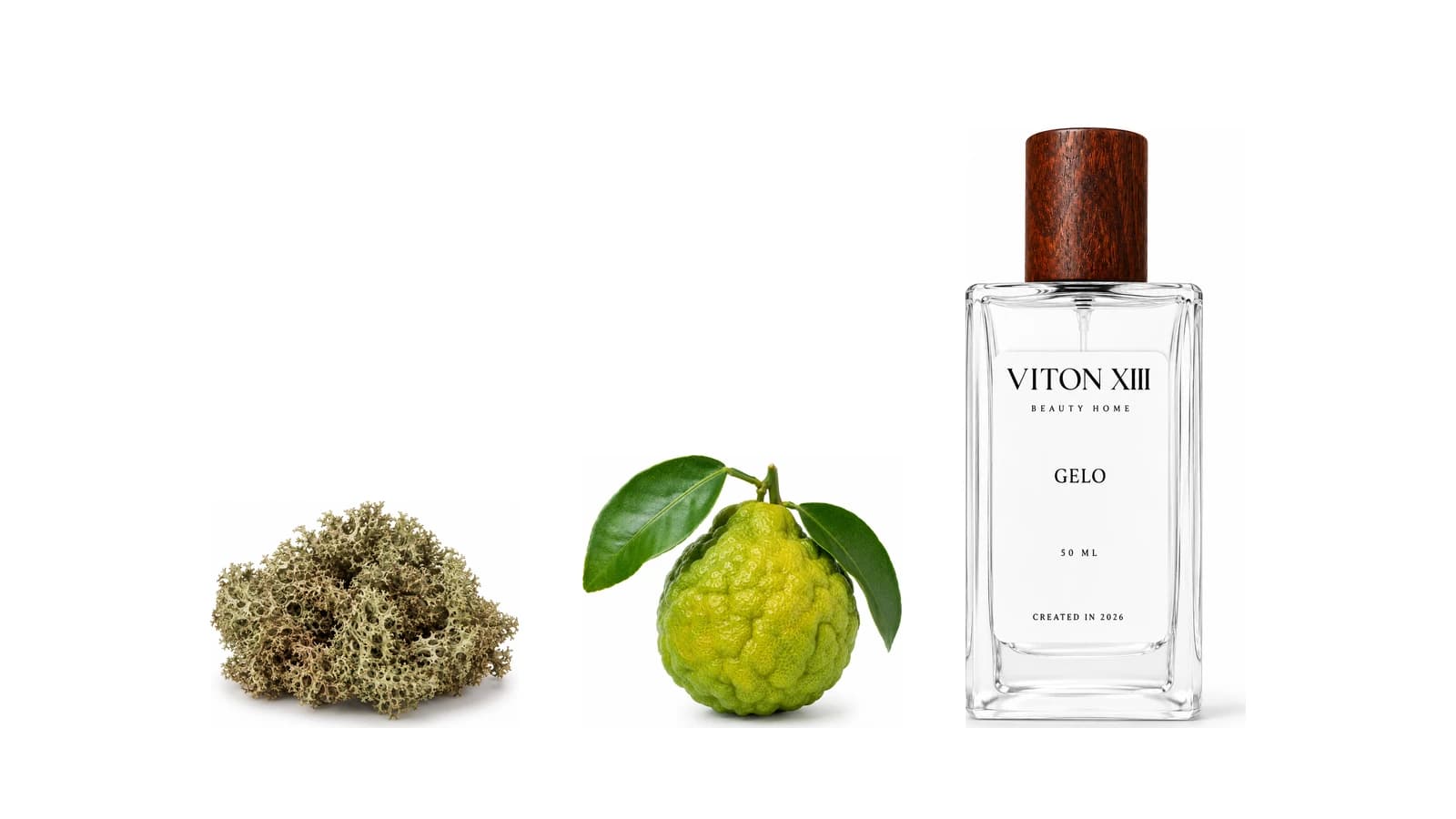
Among the five fragrances of the VITON XIII line, GELO is the one built on this structure: a fruity chypre for him. Its top is apple, blackcurrant, pineapple and bergamot. The heart brings birch, jasmine and juniper, and the base holds oakmoss, vanilla and ambergris. The store describes it as opening on cold, almost unripe fruit with a dark resinous edge, never sweet at the start, before smoke from birch and cold juniper turn the fruit into a chypre.
The base is described as damp forest and salty skin, warmed from below by vanilla. That is the contrast of the family in one sentence. The store lists GELO for him, but the structure itself is not tied to a gender and suits anyone who enjoys a bright start and a mossy finish.
You do not have to decide from a description. Every bottle is sold sealed with a sample of the same fragrance outside the seal: wear the sample first and open the bottle only if the scent is yours. While the seal is intact, the bottle can be returned within 14 days of delivery. The scent finder compares the notes of a perfume you already love and names the closest of the five, and the kitchen test on each fragrance page offers three everyday hints for the top, heart and base, which are hints rather than copies. If perfume has irritated your skin before, patch-test first.
Practical checklist
- Read the notes: look for citrus at the top and moss, labdanum or patchouli at the base.
- Test on skin rather than paper, then judge again about half an hour later, when the base appears.
- If perfume has irritated your skin before, patch-test a small area and ask a doctor.
- Do not expect a new chypre to match an older bottle: oakmoss is restricted and formulas change.
- Try the GELO sample from the sealed bottle before deciding whether to open it.
Questions and answers
Is a chypre perfume made only for women or only for men?
No. Chypre describes how a scent is built, not who wears it. Sources define the family by its citrus, resin and moss structure and say nothing about gender. Stores may label a given fragrance for him or for her.
Does every chypre still contain oakmoss?
The classic definition includes it, but Wikipedia notes that oakmoss use is highly restricted and that many scents were reformulated with other chemicals. Whether a particular bottle contains it depends on its formula.
Can oakmoss cause an allergic reaction?
Two of its constituents, atranol and chloroatranol, are potent allergens according to the European Commission's scientific committee. A reaction usually shows about a day after use. If you suspect sensitivity, patch-test and see a doctor.
How do I tell a chypre from an amber or woody perfume?
Look for the contrast of bright citrus against a mossy, resinous base. The families overlap, and a fragrance wheel from 1983 puts chypres between amber and woody, so shops sometimes file the same perfume under different headings.
Why is it called chypre if the perfume is not made in Cyprus?
Chypre is simply the French word for the island. Wikipedia says the name refers to Cyprus and that the raw materials came mainly from Mediterranean countries. Today it names the structure, wherever a perfume is made.