
Answer in brief
A pear note in perfume is a composition that reads as ripe pear, not an oil pressed from the fruit. It belongs to the top of the scent, so it is strongest in the first minutes and then gives way to the heart and the base. Judge a pear scent after an hour, when you can smell what it turns into.
What a pear in a perfume is supposed to smell like
Anyone typing pear perfume into a search bar has a picture in mind: a ripe, juicy, slightly watery fruit, the kind you eat leaning over the sink. A bottle does not contain that fruit. It contains a composition which, when it reaches the nose, is read as pear. The reading is the whole point, and it is why two perfumes with the same word on the label can smell quite different.
In perfumery that word is called a note. Wikipedia’s article on notes defines them as descriptors of scents that can be sensed upon the application of a perfume, and sorts them into three classes: top, middle (also called heart) and base. The classes are about time, not about quality. Pear belongs to the first class, and almost everything useful about pear scents follows from that.
Why the fruit itself is rarely in the bottle
Wikipedia’s article on perfume says that fresh fruits rarely yield the expected odors when extracted, so fruit notes are more likely to be of synthetic origin. It names a few exceptions, among them blackcurrant leaf, litsea cubeba, vanilla and juniper berry. Pear is not on that list. A pear note is therefore not squeezed or distilled from pears in the way a citrus rind can be pressed.
The same article adds three things worth knowing before you judge the word synthetic. Synthetic aromatics are much more consistent than natural ones, which vary with the supplier, the harvest place and the processing. They are usually a single main compound, and that compound can smell different when used undiluted than it does in nature. And they are not necessarily cheaper than naturals. Synthetic, in other words, describes how the pear is made available, not how good it is.
The chemistry of a ripe pear
A research team writing in Frontiers in Plant Science measured the volatile compounds of a Docteur Jules Guyot pear and found alcohols, aldehydes, esters, acids, ketones, alkanes and terpenes. Esters were the main aroma substances, and their content rose as the fruit ripened. At room temperature the hexyl acetate in the fruit climbed from 102.7 to 9,526.2 micrograms per kilogram over 14 days, and total esters from 120.3 to 14,754.6.
Read those numbers as a story about timing. A hard pear hardly smells of anything, and the smell most people call pear is a chemical event that arrives with ripeness. The same study found that the aroma content under cold storage was lower than at room temperature and rose quickly once the fruit was moved back into the warmth. The picture a perfumer chases is therefore the ripe moment, not the green fruit.
One molecule has even been nicknamed after the fruit. Wikipedia lists ethyl decadienoate, called pear ester, as having a pear-like taste and odor, and says it occurs in apples, Bartlett pears, Concord grapes, beer, pear brandy and quince. It is used in flavors and fragrances. A single molecule can lend its pear character to several fruits, so the line between pear, apple and quince is blurrier on a scent strip than on a market stall.
Why pear sits at the top and goes first
According to Wikipedia, top notes are perceived immediately and consist of small, light molecules that evaporate quickly, while base notes are large, heavy molecules that evaporate slowly. The article ranks perfumery materials on an evaporation scale from 1 to 100: top notes fall between 1 and 14, middle notes between 15 and 60 and base notes between 61 and 100. A bright fruit like pear is a classic resident of the first band.
The timing is given in the same place. Scents of the middle class disappear anywhere from twenty minutes to one hour after application, and base notes are usually not perceived until thirty minutes in. In the first minutes a pear perfume is all pear, and then it shrinks to a faint edge. That is not a defect. The pear is the greeting, and the rest of the composition is what you will be talking to for the afternoon.
Treat the minutes as a rough guide rather than a stopwatch. The article itself carries notices that some statements need better citations, and every perfume is a blend in which fast and slow materials overlap. What survives the caveat is the order: pear first, the heart next, the base last.
Juicy pear against pear with spice, flowers or warmth
Wikipedia’s description of fragrance families helps here. The fruity family features fruits other than citrus, while the gourmand family covers scents with edible or dessert-like qualities, often built on vanilla, tonka bean and coumarin. The same article warns that a family is insufficient to fully characterize a scent and that a fragrance can belong to more than one. Pear on its own leans fruity; pear next to vanilla leans toward gourmand; pear next to petals reads as floral fruit.
Spice is another neighbour. Pink pepper is the usual choice, and it is worth knowing what it is. Wikipedia explains that pink peppercorns are not related to commercial pepper, Piper nigrum, and that the name covers dried berries from different species, sold under it because they resemble peppercorns and taste peppery. Beside a plain fruit that peppery character tends to give the sweetness an edge, so the pear stops being a bowl of fruit and becomes something drier.
A caution belongs here, because spice and flowers are where sensitive skin most often objects. The same Wikipedia article notes that pink peppercorn berries belong to the cashew family and may cause allergic reactions in people with tree nut allergies when eaten. That says nothing about any particular bottle. If your skin is sensitive or you have allergies, patch-test a scent on a small area first and ask a doctor, who can judge your case.
A fruity opening says little about the base
Because the pear leaves first, the first minute is the least reliable part of the test, and it is also the part that most shops and strips show you. Wikipedia notes that the scent of base notes in the dry-down is often altered by the heart notes above it. A pear with a floral heart settles in one direction, and the same pear above a dark, roasted or woody heart settles in quite another.
So read a notes list as a route, not as a label. In a pear perfume, the fruit at the top tells you where the scent starts and nothing about where it stops. Two perfumes can begin with the same juicy fruit and end up in different families, one clean and close to the skin, the other warm and sweet. The only honest way to know the ending is to wait for it.
How to judge a pear scent after an hour
Put one scent on one spot and nothing else. Write down what you smell at five minutes, at thirty and at sixty. By the hour mark, by the timings above, the top has done its work and the base has had its half hour, so you are meeting the scent you would actually live with. If the pear is all you liked, you may have just fallen for the greeting.
Allow for your own nose. Wikipedia defines olfactory fatigue as the temporary, normal inability to distinguish a particular odor after prolonged exposure, and it affects the person wearing a scent more than anyone near them. Step out of the room, come back, or ask someone you trust. The same article mentions a study in which coffee beans, which sellers often offer as a nasal palate cleanser, did no better than lemon slices or plain air, so do not count on them to reset your nose.
Test on skin when you can, not only on paper, and test one at a time. Stacking four sprays on two wrists leaves you judging a mixture that no bottle contains. Come back to a scent on a second day before deciding, because a first impression of a fruit is the easiest one to get wrong.
Oh my God: pear first, then coffee and vanilla
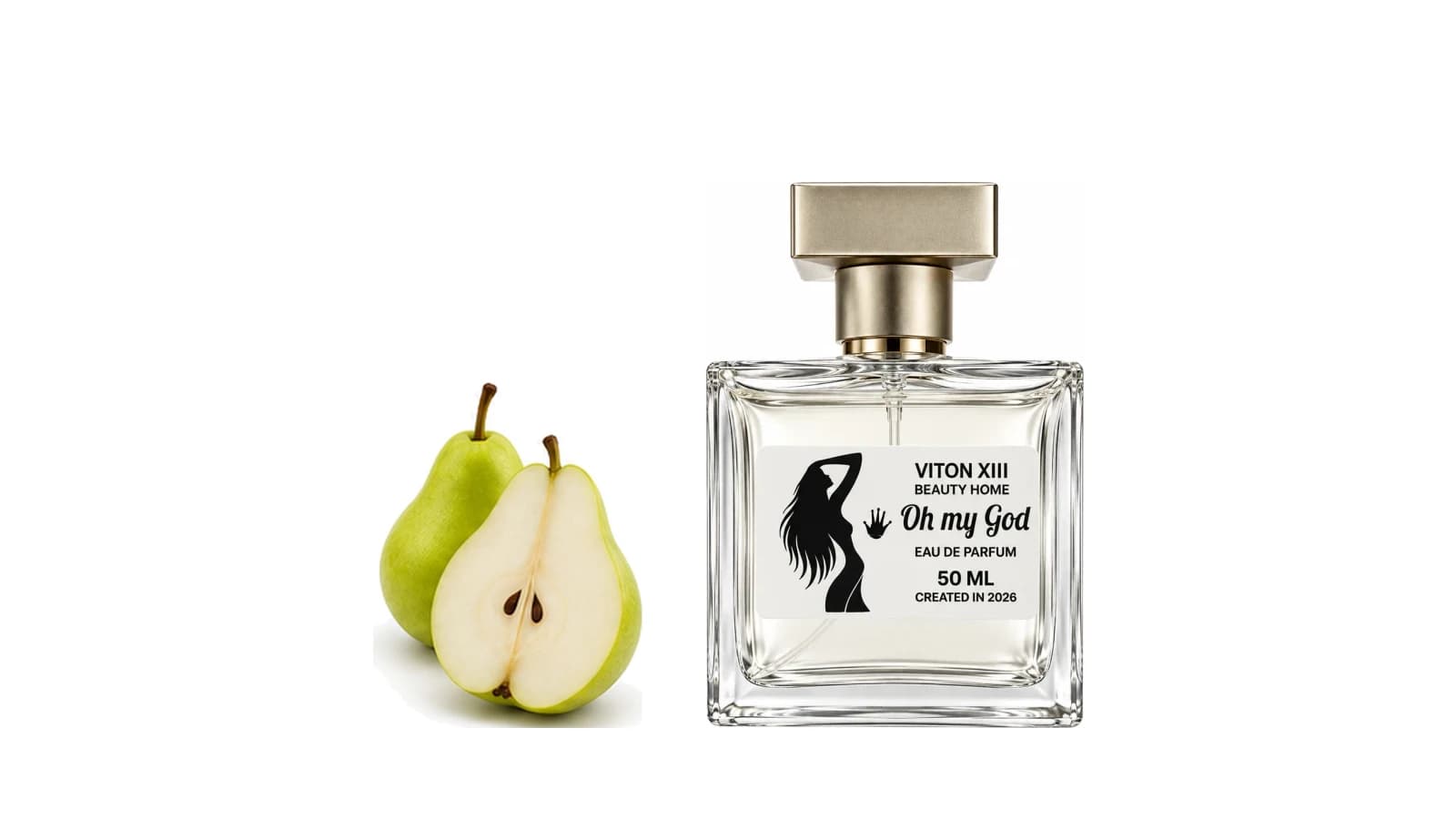
Of the five perfumes in the VITON XIII line, the one that opens on pear is Oh my God, a floral amber gourmand listed for her, sold as an Eau de Parfum in a 50 ml bottle. Its top notes are pear, pink pepper and orange blossom; the heart is coffee, jasmine, bitter almond and licorice; the base is vanilla, patchouli, cashmere wood and cedarwood. The store describes the opening as juicy pear with a sparkling, rosy pink pepper, then roasted coffee softened by jasmine and orange blossom, and a base where patchouli keeps the vanilla elegant rather than sugary.
That is the pattern described above: a fruit greeting that leads somewhere else. To check it for yourself, paste the notes of a perfume you already love into the scent finder, which compares notes and families and names the closest of the five. Each fragrance page also lists three things from an ordinary kitchen that stand in for its top, heart and base; they are hints, not copies. Every bottle is sold sealed, with a sample of the same fragrance outside the seal. Wear the sample for an hour first and open the bottle only if the scent is yours. While the seal is intact, the bottle can be returned within 14 days of delivery.
Practical checklist
- Wear one scent on one spot and note what you smell at five, thirty and sixty minutes.
- Read the full list of notes, not only the first line: the pear tells you the start, not the end.
- Patch-test on a small area if your skin is sensitive, and ask a doctor about allergies.
- Leave the room and return before judging, because your nose adapts to a scent you wear.
- If you like a pear opening with coffee and vanilla, wear the Oh my God sample before opening the bottle.
Questions and answers
Does pear perfume contain real pear?
Usually not in a way you could extract. Wikipedia’s perfume article says fresh fruits rarely give the expected odors when extracted, so fruit notes tend to be built from other materials. Judge the scent by how it smells, not by how it is made.
Why can’t I smell the pear after a few minutes?
Two things happen together. Pear is a top note made of small, light molecules that leave quickly, and your nose also adapts to a smell it has been breathing for a while. Step away, return, and you will usually find the heart and base instead.
Is pear a note for women or for men?
A note has no gender; the surrounding notes decide the character. Pear with petals reads soft and floral, with vanilla and coffee it turns sweet and warm, and with wood or smoke it can read drier. Choose the whole list, not the fruit.
How long should I wait before deciding on a scent?
An hour is a practical minimum. By then the top notes have faded and the base has been present for a while. If you can, wear it for an afternoon and return to it on a second day, because a fruit opening is easy to love and hard to live with.
Can pear notes irritate sensitive skin?
Any scent can bother someone, and the pear itself is rarely the cause; the other ingredients matter as well. If your skin is sensitive, test a small area first and wait a day. Ask a doctor about allergies, because only a specialist can judge your case.