
Answer in brief
A geomagnetic storm is a disturbance of Earth's magnetic field driven by the solar wind. NOAA measures it with the Kp index and calls Kp 5 and above a storm, graded G1 to G5. As of 18 October 2026, the month had G2 on the 4th, G1 on the 5th and G3 on the 10th, and NOAA expected G1 on 20 October. Research on health effects remains inconsistent.
A geomagnetic storm, the Kp index and NOAA's G1–G5 scale
A geomagnetic storm is a major disturbance of Earth's magnetic environment, caused when the solar wind, the stream of charged particles from the Sun, pours energy into the space around the planet, as NOAA's Space Weather Prediction Center puts it. Its strength is read on the Kp index from 0 to 9; NOAA counts Kp 5 and above as a storm, graded G1 (minor) to G5 (extreme). Reliable forecasts reach about three days ahead, so a month-long calendar of storm days is an outlook at best.
NOAA's page on the planetary K-index explains the number: magnetometers record how far the horizontal part of the field swings in each three-hour block, and Kp averages 13 observatories between 44 and 60 degrees of geomagnetic latitude. Kp 5 is G1, Kp 6 is G2, Kp 7 is G3, Kp 8 is G4 and Kp 9 is G5. NOAA's table puts the average at 1,700 G1 events per 11-year solar cycle and only four G5.
The limit on forecasts comes from physics. NOAA's description of its alert products says a storm Watch can look up to 72 hours ahead, with lower confidence in both timing and strength. A Warning, based on solar wind measured before it reaches Earth, carries higher confidence but comes only minutes to a couple of hours in advance. The fastest coronal mass ejections, NOAA notes, cross from the Sun to Earth in 15 to 18 hours.
Storm levels recorded in October 2026 up to 18 October
As of 18 October 2026, NOAA's alerts showed three days at storm level this month. On 4 October the K-index reached 6 at 20:57 UTC, level G2, moderate. On 5 October a minor G1 followed, which NOAA's weekly summary tied to a fast solar wind stream from a coronal hole. The strongest came on 10 October: a K-index 7 alert at 17:58 UTC, level G3, strong, after coronal mass ejections observed on 6 and 7 October.
The Space Research Institute of the Russian Academy of Sciences, IKI RAS, followed the event from Moscow. Its solar astronomy laboratory wrote late on 10 October that the strongest magnetic storm in three months had been registered since about 20:00 Moscow time at level G3. The last storm of comparable strength, it added, had come on 4 July 2026. By 16 October the laboratory counted the fifth day in a row without geomagnetic disturbances.
Forecasts moved along the way. On 9 October NOAA's watch expected G1 for 9 and 10 October and G2 for the 11th; the G3 storm came on a day forecast as G1, and the G2 watch was cancelled. IKI RAS had expected G2 that evening and another G2 around midday on Sunday 11 October. NOAA's weekly outlook of 12 October expected G1 on 13 October, yet its daily data show a top Kp of 3.33 that day.
Reading NOAA's three-day forecast and the IKI RAS storm page
NOAA's 3-Day Forecast is the plainest official product. It is issued at 00:30 and 12:30 UTC and gives the expected Kp for each three-hour block of the next three days, the matching G level and the forecaster's reason. The issue of 12:30 UTC on 18 October 2026 put the highest Kp at 4.67, marked G1, on 20 October, because of a high-speed stream from a coronal hole. Times are in UTC; Moscow is three hours ahead.
The 27-day outlook, issued on Mondays, lists the largest expected Kp for each day four weeks ahead. NOAA notes that persistent coronal holes can survive several 27-day solar rotations, and its weekly forecast of 12 October put every expected rise in activity down to recurrent coronal hole streams. An eruption that has not happened cannot appear in such a table: the outlook of 12 October gave 20 October a Kp of 2.
In Russia, the IKI RAS laboratory publishes on xras.ru the current Kp, a three-day forecast for middle latitudes, a calculated probability of storms and a chart for the next 31 days. On 18 October 2026 its 24-hour forecast was a calm field with Kp 2+. IZMIRAN, the Academy's Pushkov Institute of Terrestrial Magnetism, runs its own Space Weather Prediction Center with alerts and forecasts of daily indices. When sources disagree, the newer issue deserves more weight.
Solar cycle 25 after its maximum and what 2026 inherits
On 15 October 2024 NASA, NOAA and the international Solar Cycle Prediction Panel announced that the Sun had reached the solar maximum period of its roughly 11-year cycle, which could last another year. NOAA's Elsayed Talaat said the peak month would not be identified for months or years. SIDC, the Royal Observatory of Belgium's solar data centre, which keeps the international sunspot number, now names it: the smoothed sunspot number of cycle 25 peaked in October 2024 at 161.
Past the peak does not mean quiet. SIDC expects the Sun to stay at a similar level of activity well into 2026 and lists important storms in October 2024, June 2025 and January 2026. NOAA's monthly table shows the sunspot number falling from 165.8 in October 2024 to a preliminary 60.3 in September 2026, and NOAA notes that coronal holes, a source of G1 and G2 storms, are more common around solar minimum. NOAA expects cycle 26 to begin between January 2029 and December 2032.
What a strong storm does to power grids, satellites and GPS
NOAA's scale describes the effects on technology level by level. At G1 it lists weak power grid fluctuations and a possible minor impact on satellite operations. At G2, high-latitude power systems may see voltage alarms and HF radio can fade at higher latitudes. At G3, the level of 10 October, grids may need voltage corrections, satellites in low orbit meet more drag, and satellite navigation and HF radio may work only intermittently.
NOAA's page about geomagnetic storms explains the mechanism. Heat from currents and particles raises the density of the upper atmosphere and slows satellites in low orbit, and uneven density in the ionosphere bends radio signals and creates errors in GPS positions. Storms also induce currents in power grids and pipelines. At G5 NOAA warns that some grids may collapse, while its G1 watch of 17 October placed the main area of impact poleward of 60 degrees geomagnetic latitude.
Magnetic storms and human health in peer-reviewed research
Health is where storm calendars promise most and science says least. A scoping review by Belenko, Cancel and Mayrovitz in the journal Cureus, published on 22 December 2025 and indexed in PubMed Central, screened 1,718 articles from 1964 to 2023 and kept 36 studies of adults: 28 reported significant links between geomagnetic activity and heart or stroke outcomes, eight found none. Many studies, the authors write, use ecological designs with uncontrolled factors; causality cannot be inferred, and the observations remain preliminary.
NOAA's G scale lists effects on technology and migratory animals and names none on people; radiation risks for astronauts and for crews on high-latitude flights belong to its separate solar radiation scale. The practical conclusion is modest: a person with a heart condition should follow the plan agreed with their doctor every day and not change treatment because of a forecast, and serious symptoms call for a doctor or emergency services on any date.
Auroras far from the poles during strong geomagnetic activity
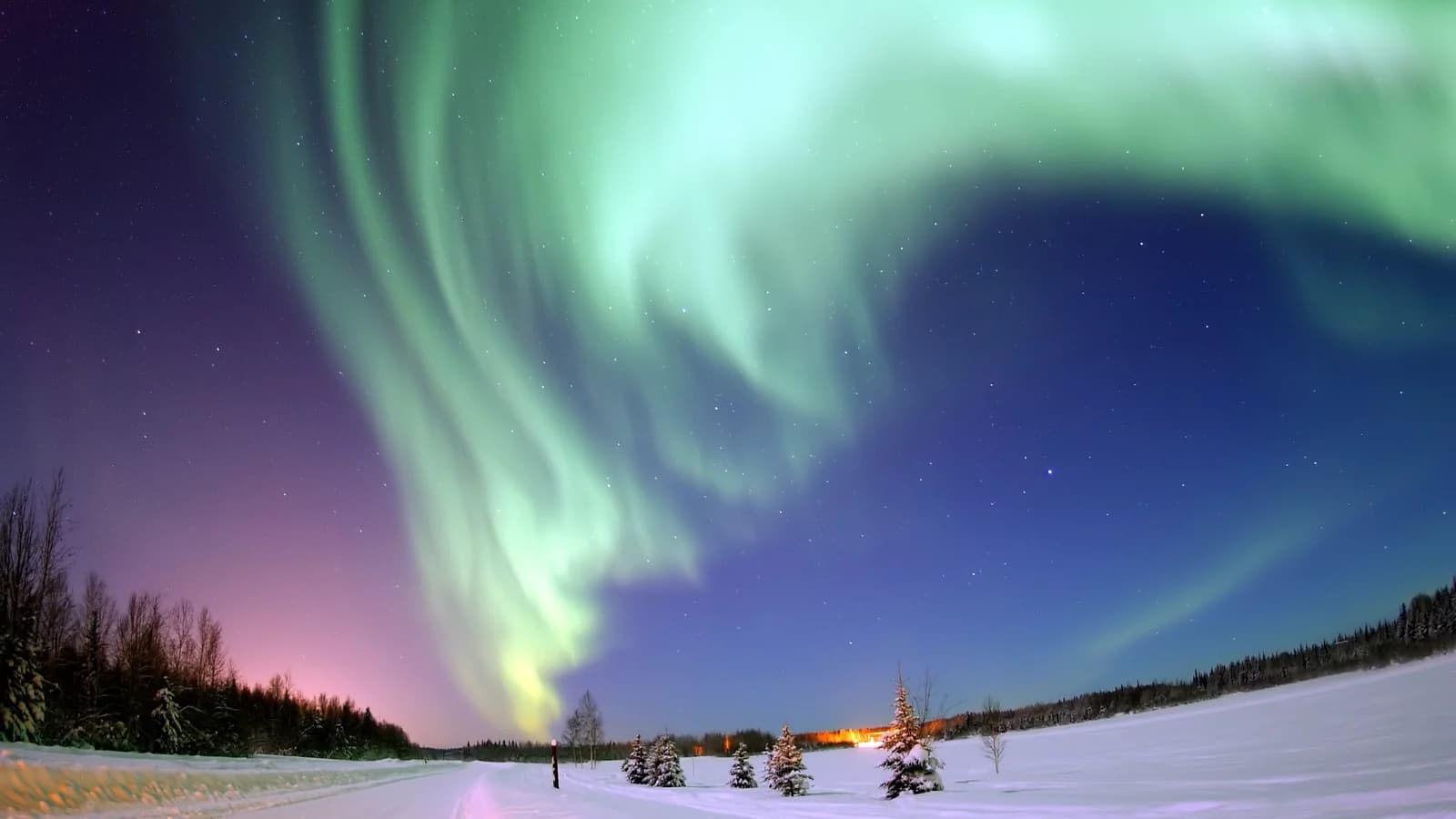
Auroras are the visible side of a storm. NOAA explains that they form in two ovals around the magnetic poles, 80 to 500 km up, best seen between about 60 and 75 degrees of latitude. In major storms the ovals expand: NOAA's scale notes auroras typically down to 55 degrees geomagnetic latitude at G2, 50 at G3 and 40 at G5. On 10 October 2026 IKI RAS reported intense auroras from 50 degrees of geographic latitude northwards.
The dated benchmark is May 2024. NOAA first observed G5 conditions at 6:54 p.m. US Eastern time on 10 May 2024, and NASA called the event the strongest geomagnetic storm at Earth in two decades, with auroras on the night of 10–11 May seen, according to NASA's Earth Observatory, in many areas worldwide. NOAA's 30-minute aurora forecast gives 30 to 90 minutes of lead time, and a bright aurora can be seen from up to 1,000 km away when conditions are right.
Storm alerts and the outlook for late October 2026
Alerts cost nothing. NOAA's subscription service emails its alerts, watches and warnings within moments of issue, and its alert page and 3-day forecast need no account. In Russian, the xras.ru storm page of IKI RAS shows the current Kp, the three-day forecast and the month's record, and IZMIRAN posts alerts on its space weather site. One bookmarked source, checked the evening before, is enough for most readers.
As of 18 October 2026, the known part is short. NOAA expects a minor G1 storm on 20 October, and its outlook of 12 October also flagged G1 for 31 October and 1 November; a new 27-day outlook is due on Monday 19 October. NOAA's forecast discussion of 18 October saw no Earth-directed coronal mass ejections. IKI RAS wrote on 16 October that sunspot group 4551 carried the highest risk category, with models giving it about 70% odds of M-class flares and 10–15% of an X-class flare. Whether it fires towards Earth nobody can forecast.
Practical checklist
- Bookmark NOAA's 3-Day Forecast and read it after the 00:30 and 12:30 UTC issues.
- Add three hours to NOAA's UTC times to get Moscow time before planning around a storm.
- Subscribe to NOAA's free email alerts if your work depends on HF radio or satellite navigation.
- Treat any month-long list of storm days as an outlook and recheck it three days before the date.
- Keep any heart treatment exactly as agreed with your doctor, whatever the storm forecast says.
Questions and answers
Is there a geomagnetic storm today, and where can I check it?
Look at NOAA's alert page and its 3-Day Forecast, refreshed at 00:30 and 12:30 UTC, or at the xras.ru storm page of IKI RAS, which shows the current Kp in Moscow time. A Kp below 5 means no storm on NOAA's scale; in NOAA's issue of 12:30 UTC on 18 October 2026, the top Kp of the previous 24 hours was 3.
Can I trust a list of storm days for the whole of October 2026?
Only as a rough outlook. NOAA's 27-day table and similar month-ahead charts follow recurring coronal hole streams, but they cannot include an eruption that has not happened yet. In October 2026 the strongest storm, G3 on the 10th, fell on a day for which NOAA's watch had expected only G1.
Do geomagnetic storms affect how people feel or their heart health?
Research has not settled it. A scoping review in Cureus from December 2025 looked at 36 studies on heart and stroke outcomes: 28 reported correlations, eight found none, and the authors say causality cannot be inferred. Anyone with a heart condition should keep to the treatment their doctor set.
Which Kp value counts as a geomagnetic storm on NOAA's scale?
Kp 5 is the threshold. NOAA labels Kp 5 as G1 (minor), Kp 6 as G2 (moderate), Kp 7 as G3 (strong), Kp 8 as G4 (severe) and Kp 9 as G5 (extreme); its forecasts also mark 4.67 as G1. NOAA still sends alerts when Kp reaches 4, but that level sits below the storm scale.
Can the northern lights be seen far south of the Arctic during a strong storm?
During strong storms, yes. NOAA's scale records auroras seen down to about 50 degrees geomagnetic latitude at G3 and 40 degrees at G5, and on 10 October 2026 IKI RAS reported auroras from 50 degrees of geographic latitude north. NOAA adds that the sky has to be clear and dark.