
Answer in brief
VITON13’s seven new concept websites are ROKO, HYPERSOLID, Möbius, VOXA, HOURLINE, SOLVENT and RACKLIGHT. All run live on tarasovvitalii.com/demos/, all use fictional brands and generated data, and each was measured with Lighthouse on its live address: mobile performance ranges from 43 for ROKO to 94 for HOURLINE, desktop from 61 to 100.
Seven additions to the portfolio in one week
Between 24 and 28 September 2026 VITON13 Studio published seven new concept websites. They sit on tarasovvitalii.com/demos/, the portfolio of the studio’s founder, and each has a case page in the studio’s own list of work. A concept website here means a working site or web app built for an invented brand, so that a buyer can open and use the kind of product they are thinking of ordering before any client project of that type exists.
Four of the seven are story sites that turn a scroll into a scene: ROKO, HYPERSOLID, Möbius and VOXA. Three are product demos a visitor can actually operate: HOURLINE for bookings, SOLVENT for cash flow and RACKLIGHT for a warehouse. The Global Control operations CRM, released the same week, has its own write-up in VJOURNAL.
ROKO turns a river pebble into an AI launch
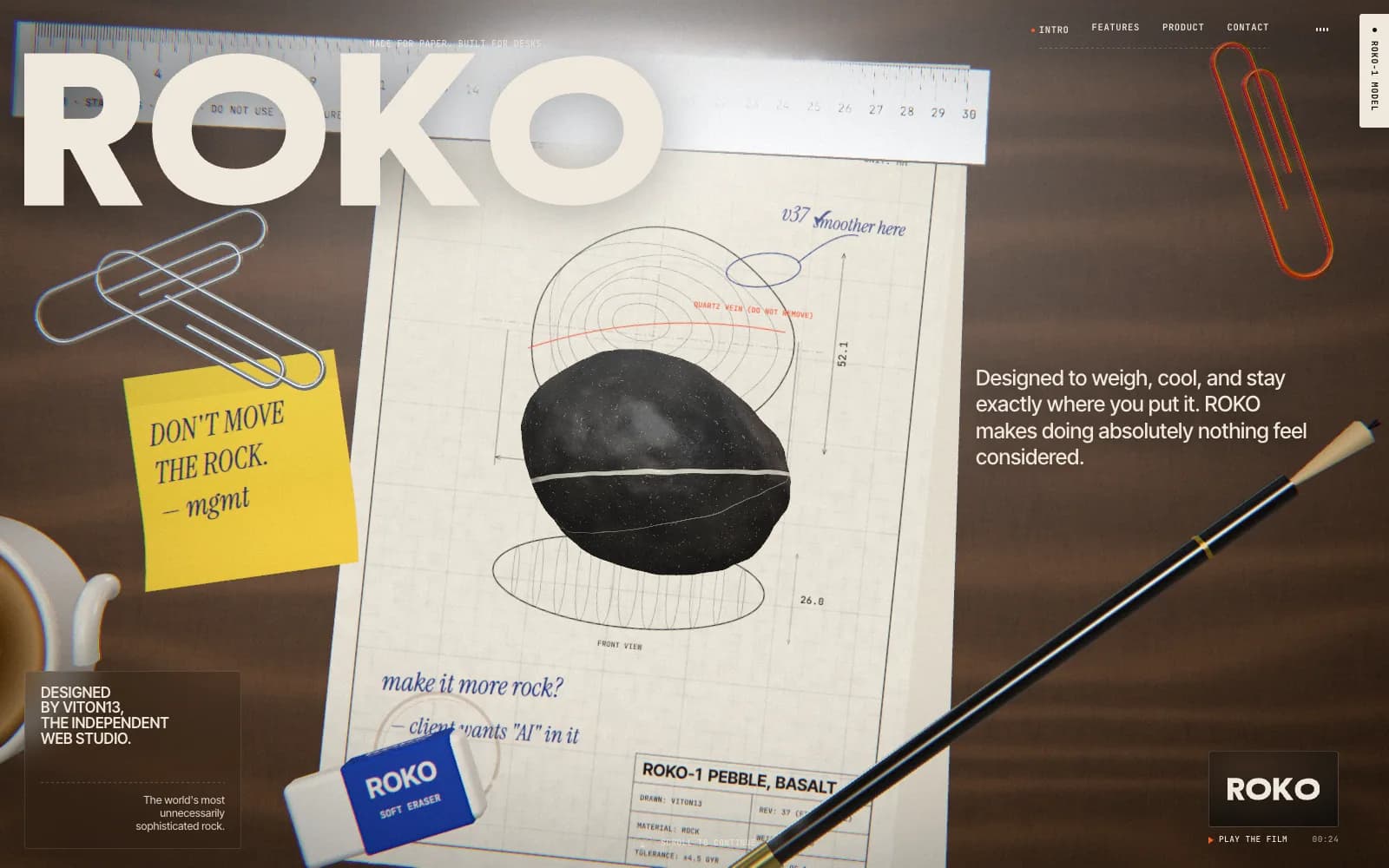
ROKO is the joke in the set, and it is also the most technical story site. The product is a river pebble sold like an AI device, “Powered by AI*”, where the footnote reads “Ancient Igneous”. One real-time 3D stone, generated in code, carries twelve scroll sections: it lifts off a walnut desk, hangs as a pendant, pins papers in the wind, lands in the O’s of the wordmark and stacks into a cairn.
Visitors can talk to a chat where the stone thinks for 4.5 billion years and answers with an ellipsis, dress the live pebble in sunglasses or a crown, switch it into a thermal camera mode and download its “open weights” as a real .obj file. The structure follows Lusion’s oryzo.ai, where one object carries the whole page; the product, copy, 3D and images are the studio’s own. Photos with people and three short films were generated with the studio’s render of the pebble as the reference, and the case says so.
VOXA, Möbius and HYPERSOLID as single 3D worlds
VOXA is a fictional voice-first bank. A camera flies through one three.js world with ten features, and each opens a working phone app: paying a friend by voice with an in-browser voiceprint check, saving for a shared goal, a flight that turns into a boarding pass, a card designer. The voice parser understood all 56 test phrases, 28 in English and 28 in Russian.
Möbius is a concept for a school and institute for ages 5 to 25. On the home page 40 story cards ride a real Möbius band in three.js, and behind it sit programmes, admissions tools, a campus map and a demo of the personal account for students, parents and teachers across 19 screens. HYPERSOLID, published on 24 September, is the site of an invented creative-technology studio rendered as one scene: a glass tesseract rotating in four dimensions, five scroll chapters and a ring of eight live shader worlds.
HOURLINE, SOLVENT and RACKLIGHT as working products
The three product demos are closer to software than to marketing sites. HOURLINE is a booking platform for a network of three fictional studios in Moscow, Dubai and London: a guest books on a phone in about six seconds (the median of 14 scripted runs), and the studio side has a calendar with drag and drop, a no-show risk score and a tool that fills empty time. An independent check re-tested 658 offered times and found no conflicts.
SOLVENT is a cash-flow cockpit for an invented 14-person studio. It shows cash, runway and an 18-month forecast, and eight levers redraw the forecast at once, with a waterfall that shows what each one changes; 1,927 automated checks of the maths pass. RACKLIGHT is a warehouse management concept in which 1,656 bin locations are live 3D pallets: search flies the camera to a bin, and the pick-path optimiser shortened the median walk by 32% against the order sheet across 1,140 generated orders. All three are labelled as concepts and state that their assistants are rules and statistics running in the browser, not a language model.
Shared engineering under seven different faces
The seven concept websites look nothing alike, but they are built on the same principles. Each is a static folder with relative addresses, so it runs from any path without a back end of its own, and each works on data generated in the browser: the bookings, balances and pallets a visitor sees are created on the spot for that visit. Five of them are available in English and Russian; ROKO and HYPERSOLID are in English only.
Five of the seven draw their main scene with three.js, the JavaScript library for WebGL, while HOURLINE and SOLVENT are interface-first apps without a 3D scene. Every one of them keeps its text in real HTML rather than baking it into the picture, so headings stay readable by screen readers and search engines even when the background is a live 3D world, and all seven respect the visitor’s reduced-motion setting. The product demos go further and ship their own test suites: SOLVENT’s 1,927 checks and HOURLINE’s audit of 658 offered times are part of what the cases quote.
Lighthouse on every live address
Each demo was measured with Lighthouse on its live address, with the runs, the machine load and the medians recorded in its case. Mobile and desktop performance came out as follows: HOURLINE 94 and 100, HYPERSOLID 91 and 94, RACKLIGHT 86 and 99, SOLVENT 81 and 98, Möbius 81 and 93, VOXA 47 and 61, and ROKO 43 and 64.
The two low scores are explained in their cases rather than hidden. VOXA was measured while the machine was under very heavy load, which inflates blocking time. ROKO spends a long time on the main thread while its 3D scene starts, and its largest paint on a simulated phone arrives at 4.2 seconds. Lighthouse measures loading on a slowed-down virtual phone; it does not measure how smoothly a 3D scene runs once it has loaded, which is why the cases add frame-rate readings from a real machine.
Concept labels on every demo and case page
Every one of the seven carries a concept label on the page and in its case, and every case has a section on what it does not prove. The brands, people, balances, bookings, pallets and prices are invented. None of the demos has a client, users, traffic or revenue, and all of them are kept out of search with noindex so that the case page, not the demo, is what a search engine shows.
This follows the studio’s own guide on checking a web studio’s portfolio, which asks buyers to separate client work from concepts and own products and to look for the limits of every claim. A concept proves that a team can design and build a certain kind of site; it does not prove that the site sold anything.
Reading these demos as a buyer
The useful way to look at a concept website is to use it on the device your own customers use. Open the demo on a phone, try the main action, and see how long it takes to become usable. Then read the case: what was measured, on which machine, on which day, and what is listed under the limits.
If one of the demos is close to a project you have in mind, the case page shows which studio services it relates to and what a real version would still need: a server, accounts, integrations, content and testing on the devices of real users. The concept is a starting point for that conversation rather than a finished product.
Practical checklist
- Open each demo on the phone your customers are most likely to use.
- Find the concept label and the list of limits before reading any figure.
- Compare the Lighthouse medians in the case with how the page feels on your own device.
- Check whether the demo’s AI features are labelled as rules, statistics or a language model.
- Write down what a production version would need that the concept does not have.
Questions and answers
Which concept websites did VITON13 add in September 2026?
Seven: ROKO, HYPERSOLID, Möbius, VOXA, HOURLINE, SOLVENT and RACKLIGHT. They were published between 24 and 28 September 2026, run on tarasovvitalii.com/demos/ and each has a case page in the studio’s list of work.
Are the companies in these demos real clients?
No. Every brand, person, balance and booking in the seven demos is invented, each demo shows a concept label, and every case has a section describing what the concept does not prove.
Why does ROKO score lower in Lighthouse than the others?
ROKO runs long main-thread tasks while its 3D scene starts, and on a simulated phone its largest paint arrives at 4.2 seconds. The case lists starting the scene after the first text paints as the next step.
Do the demos use real artificial intelligence?
The booking, cash-flow and warehouse assistants are labelled as demo AI: rules and statistics running in the browser, not a language model. VOXA recognises spoken commands with the browser’s speech recognition and a voice parser built for the demo.
Can a concept website be turned into a real product?
It can serve as the starting point. A production version still needs a server, accounts and permissions, real data, integrations, content and testing with real users, and each case lists what would change first.