
Answer in brief
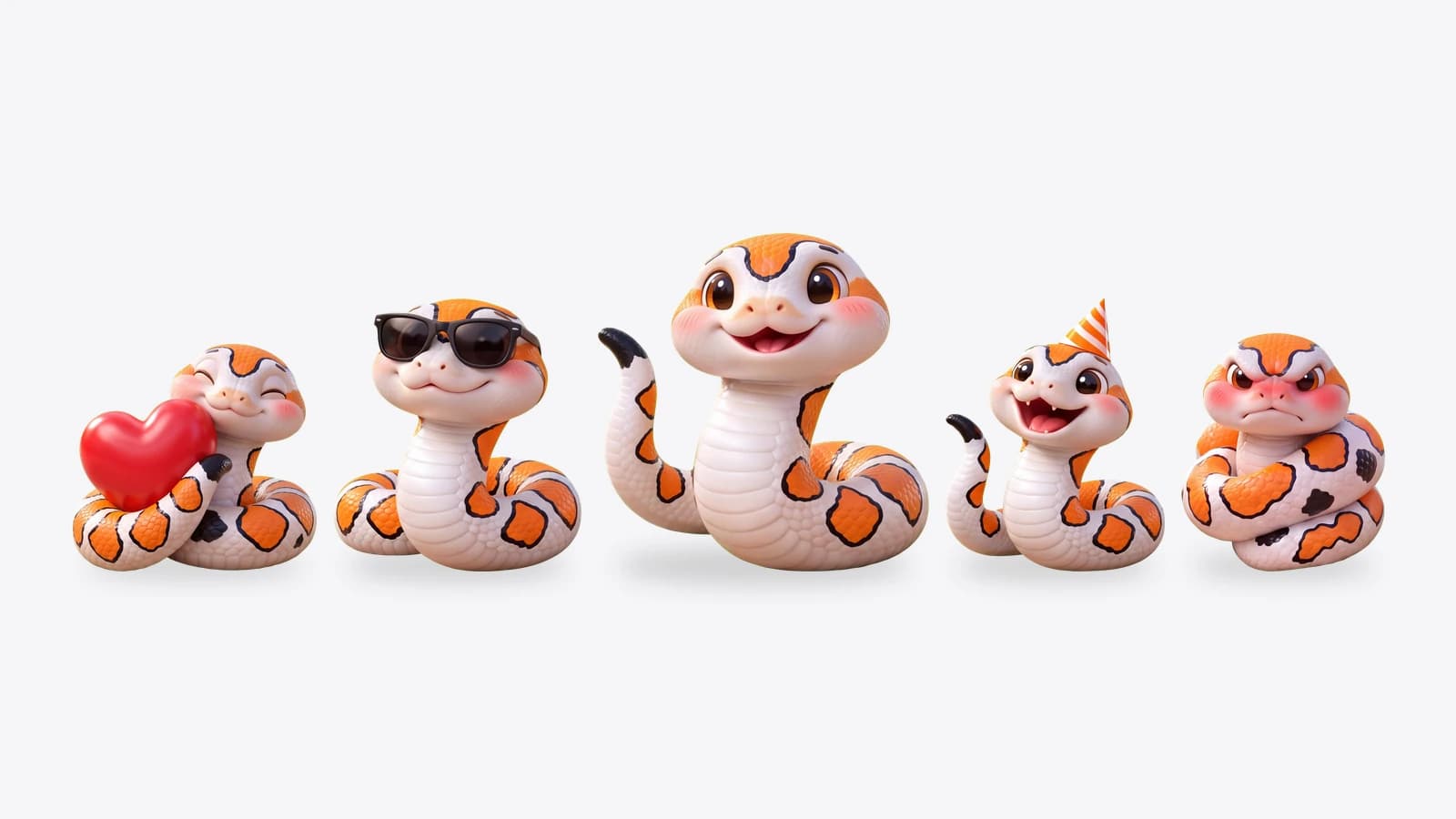
VITO is VITON13’s own brand mascot, a baby snake in pearl white, tangerine orange and black, made on 10 October 2026. The pack has 18 moods: five are six-second 3D clips and thirteen are still renders moved by code. The poses and clips were generated with AI models and cut out with the studio’s own keying script. The stickers work in the chat of tarasovvitalii.com; the Telegram pack is prepared but not published.
A logo cannot wave back
A logo is built to stay still, and it does that well. What it cannot do is answer. In a chat, under a post or at the end of a short video, people reply with faces: a wave, a laugh, a heart. A wordmark dropped into that stream reads like a stamp on a postcard.
That gap is what a brand mascot is for: a character that carries the company’s colours and can also be glad, tired, sorry or proud. On 10 October 2026 VITON13 made its own. His name is VITO, he is a baby snake, and in a single day he was designed, cut out, animated and put to work. Here is who he is, how such a character is actually produced, and what is still unfinished.
Who VITO is: a baby snake in three colours
VITO is small, round and curious. He has oversized eyes, a blush on both cheeks and a pink tongue, and he is rendered like a frame from an animated film rather than drawn as a flat icon. His job is to react the way a person on the team would, only faster and in one picture.
His colourway belongs to the studio: pearl-white scales, tangerine-orange patches with a thin black outline and a black tip on the tail. Three colours stay readable when the whole character shrinks to the size of an emoji, on the white background of a chat and on a black one.
Eighteen moods, taken from real conversations
The pack holds eighteen poses. The everyday ones are hello, thank you, love, laughing, a wink, wow, cool, party, thinking and coffee. The hard days have their own set: sleeping, crying, angry and scared. And there is a plain pose with no gesture at all, which we call “just VITO”.
Three poses come straight from studio work: “on it” shows VITO behind a laptop, “paid” seats him on a pile of coins, and “launch” puts him on a rocket. A project conversation runs through exactly these moments, and a mood that matches the moment saves a sentence. A useful test for any list of this kind: a pose that answers no message you actually send does not belong in the pack.
Sheets of nine: how one character stays the same
The poses were not drawn one at a time. They were generated with an AI image model as sheets: nine poses in one picture, all on a flat green background. Eighteen moods are two such sheets. An image model keeps no memory of a character: ask for the same snake twice with words alone, and the eyes, the pattern of the patches and the size of the head tend to wander.
The fix is to give the model something to hold on to. Each new sheet was generated with the previous sheet as the reference, so the second nine inherit the face, the proportions and the pattern of the first. Every pose is compared with a finished one, not with a description in words.
The colours were handled the same way. VITO’s first look was sand and brown. Instead of generating everything again, we edited a finished sheet: every pose stayed in place and only the colourway changed, to white, orange and black.
From a green sheet to a clean cut-out, and then to motion
A sheet is not a sticker yet. Each pose has to be lifted off the green and placed on a transparent background. Our own keying script does this: it cuts every pose out and then removes the green spill, the thin tinted fringe that a coloured backdrop leaves on the edges of a light object. On pearl-white scales that fringe shows at once.
Five moods are real animation: hello, angry, in love, laughing and crying. Each is a six-second 3D clip, generated from the still pose with an AI video model and keyed in the same way, so the moving character has the same clean edge as the static one.
The other thirteen are still renders moved by code: one bounces, one beats like a heart, one shivers. It is a shortcut, and we say so plainly: the motion is applied to a picture, and the character himself is not animated.
One set of frames, four kinds of files
Everything is exported from one set of frames, because each place a sticker goes asks for its own file. Telegram’s rules are public and strict. A video sticker must be a WebM file encoded with the VP9 codec, with one side exactly 512 pixels, no longer than three seconds, with no audio stream and at up to 30 frames per second. The file should not exceed 256 KB, and it should loop.
Custom emoji in Telegram use the same technology at exactly 100 by 100 pixels, so VITO was exported twice: as animated stickers at 512 pixels and as emoji at 100. One caveat from Telegram’s own page: anyone may create custom emoji, but adding and using custom sets is currently a feature of Telegram Premium.
For the web the same frames became two more formats. Animated WebP is the main one: according to Google it supports transparency and can be smaller than a GIF, and it keeps an 8-bit alpha channel where GIF has 1-bit alpha. A GIF pixel is either fully transparent or fully solid, so soft edges turn rough. We still export transparent GIFs, for the places that accept nothing newer.
Nineteen and a half seconds: the film Meet VITO
A character needs an introduction, so there is a short film. Meet VITO runs 19.5 seconds; it is vertical, 1080 by 1920 pixels, and in English. It was published on the studio’s Instagram account, @viton13company, on 10 October 2026 with an AI label, because the character in it is generated.
The film was not edited in a video program. It was built as an HTML scene, the same material a web page is made of, and rendered frame by frame; the soundtrack was synthesised in code as well.
Where VITO already works
Today the stickers already work in the chat of our portfolio site, tarasovvitalii.com. Open the messages there, press the sticker button and send one. The sticker is not sent as an image. It travels as a short text token, and each side of the conversation shows the picture that belongs to that token.
The full set and the film are shown in the portfolio case at tarasovvitalii.com/work/vito. VITO is VITON13’s own work, not a client commission, which is why every step can be shown, including the unfinished ones.
What is honest to say about AI in this work
The stills and the five clips were generated with AI image and video models, from our prompts and references. Nobody modelled VITO in 3D software or rigged him by hand, and there is no 3D model file. The words “3D clip” describe how the picture looks, not what sits on a disk. The practical consequence is simple: a new pose cannot be posed. It has to be generated.
The origin deserves the same precision. VITO’s first look followed a reference picture chosen by the founder; the colourway, the eighteen poses and the film are ours. A person chose, directed, compared, corrected and assembled; the models drew. The AI label on the reel says the same in public.
What is not done yet
The Telegram pack is prepared and not published: the files meet the limits, but nobody outside the studio can add the stickers in Telegram today. There are no usage numbers either. VITO is one day old, and this article reports none. And thirteen of the eighteen stickers are stills moved by code; only five show the character himself in motion.
One more limit is not ours to remove. A company cannot place its own character on the system emoji keyboard: new emoji are encoded through the Unicode Consortium, and its submission guidelines state that proposals for logos and brands are declined automatically. A mascot therefore lives in custom sticker and emoji packs, inside the apps that support them, and nowhere else.
Practical checklist
- Fix the character before the poses: a few colours that stay readable at emoji size.
- Write the list of moods from the messages your team really sends.
- Generate or draw each new batch of poses against an approved one, so the character does not drift.
- Check each platform’s published limits before exporting: size, length, format and file weight.
- Send the finished stickers in a real chat, on a light background and on a dark one.
- Say plainly which parts are generated, which are animated and which only move by code.
Questions and answers
Was VITO made with AI?
Yes. The poses and the five clips were generated with AI image and video models from our prompts and references. There is no 3D model file, a new pose means a new generation, and the intro film on Instagram carries an AI label.
Is VITO the mascot the same thing as VITO bonus points?
No. On viton13.com the word VITO also names the bonus points in a VITON ID account. The mascot shares that name, but he is a character and not the points programme, and this article is only about the character.
How many of the 18 stickers are really animated?
Five: hello, angry, in love, laughing and crying. Each is a six-second 3D clip generated from the still pose. The other thirteen are still renders moved by code, with a bounce, a heartbeat or a shiver.
Can I add the VITO stickers in Telegram today?
Not yet. The sticker and emoji files are prepared to Telegram’s limits, 512 and 100 pixels, up to three seconds and up to 256 KB, but the pack itself has not been published. Today the stickers work in the chat of tarasovvitalii.com.
Can a company put its mascot on the standard emoji keyboard?
No. Emoji are encoded through the Unicode Consortium, whose guidelines say that proposals for logos and brands are declined automatically. A brand character can live only in custom sticker and emoji packs, inside the apps that support them.