
Answer in brief
A cash flow forecast, or payment calendar, lists expected receipts and payments by date and shows the balance after each day or week. Unlike a profit report, it follows the money, so it shows a cash gap before it happens. A spreadsheet updated weekly is enough to start; scenarios such as a late client or a new hire show what a decision does to the runway.
A cash flow forecast is a dated list of money in and out
Salaries are due on Friday and the biggest client has not paid. Russian practice calls the tool for this moment a payment calendar; in English it is a cash flow forecast. Wikipedia defines forecasting cash as obtaining an estimate of a company's future cash levels, and its direct method as scheduling cash receipts and disbursements. In practice it is a table: dates across the top, expected money in and out down the side, a running balance at the bottom.
That balance is what separates the forecast from a profit report. The U.S. Small Business Administration describes two ways to keep books: the accrual method records a sale as soon as it is completed, the cash method only once payment arrives. Its comparison credits the cash method with showing cash flow clearly and lists potentially deceiving figures among the drawbacks of accrual. So a month can be profitable on paper and empty in the bank.
Two other documents have similar names. The statement of cash flows, set by IAS 7, a standard of the IFRS Foundation, looks back and sorts a period's cash flows into operating, investing and financing activities. A cash flow budget plans the same flows a month or a quarter ahead. A payment calendar goes down to days and weeks and asks whether the account holds enough on the 10th for what falls due that day.
Why a profitable company still runs into a cash gap
Russian accountants call the day that answer is no a cash gap. Russian Wikipedia defines it as a temporary lack of the money needed for expenses already due, and notes that it can happen to any organisation, company or state. The cause always has one shape: money arrives later than it must leave. The definition says nothing about losses.
English Wikipedia's article on cash flow is blunt: a company can fail because of a shortage of cash even while profitable. The reasons are familiar. A client pays forty-five days after the invoice while rent is due on the first. A shop buys seasonal stock months before selling it, and a quarterly tax payment lands in the same week.
Russian Wikipedia's article on budget balance warns from both sides. Steering only by profitability threatens cash gaps and a constant shortage of money, while steering only by cash flow can hide the absence of real profit. The article also asks for a liquidity reserve for unplanned payments and late receipts. For a small company that reserve is a minimum balance the forecast should never cross.
Building a first payment calendar in a spreadsheet
A spreadsheet is enough to start. Wikipedia notes that small firms commonly keep one showing cash coming in from all sources out to at least 90 days, with cash going out over the same period. Begin with today's balance in the accounts and the till. IAS 7 defines cash as cash on hand and demand deposits: money invoiced or promised is not cash yet.
Then enter the payments you already know: rent, salaries, loan repayments, subscriptions, and taxes on the dates your accountant gives you. Next come the costs that follow the volume of work. Use weeks for the first quarter, since a monthly total can hide the one Tuesday when the account dips below zero. Further out, months will do.
Receipts are the hard part. Put each invoice on the date this client usually pays, not the date printed on it. Wikipedia is frank about why: it is rare for cash receipts to match sales forecasts exactly, and rare for customers all to pay on time. Each week, replace the past week with actual figures and roll the table forward.
Scenarios, runway and a cash buffer for real decisions
A cash flow forecast is rarely right to the dollar, and that is not its job. Its job is to show what a decision does before it is made. Move the biggest client's payment a month later, add two salaries from March or raise prices, and watch where the lowest point falls against the buffer. Change one thing at a time and keep the baseline in view.
The number that sums it up is runway: the months the money lasts at the current pace. Wikipedia's article on burn rate defines that rate as the speed at which a company consumes its cash and notes that, with the available funds, it gives a measure of time. Cash divided by the monthly net outflow is the rough version. A dated forecast names the first day the balance drops below zero.
SOLVENT, a concept cash-flow cockpit from VITON13 Studio
SOLVENT, built by VITON13 Studio, is not a client project and not a launched product. It is a concept cash-flow cockpit and what-if simulator shown on the books of Kite & Co., a fictional design-and-print studio with 14 people, ten named clients, fourteen software subscriptions and a lease. Every figure is made up and generated in the browser. Every screen says so, and says that it is not financial advice.
The cockpit answers three questions an owner asks before payroll: how much cash there is, how long it will last, and what happens after a hire, a price rise or the loss of the biggest client. It opens on cash today: $148,210, the closing balance of the operating account. Next to it sits a runway of 14.8 months. Runway is defined on the page as the time until the projected end-of-day balance first drops below zero.
One chart holds 12 months of actual balance and 18 months of forecast, with an 80 % band taken from the model's own past error, the buffer and the day the money would run out. Every figure on the screen comes with its definition. In the generated books each client keeps its usual lateness. In the forecast, open invoices arrive on the client's usual payment date.
Eight SOLVENT levers and a waterfall that adds up exactly
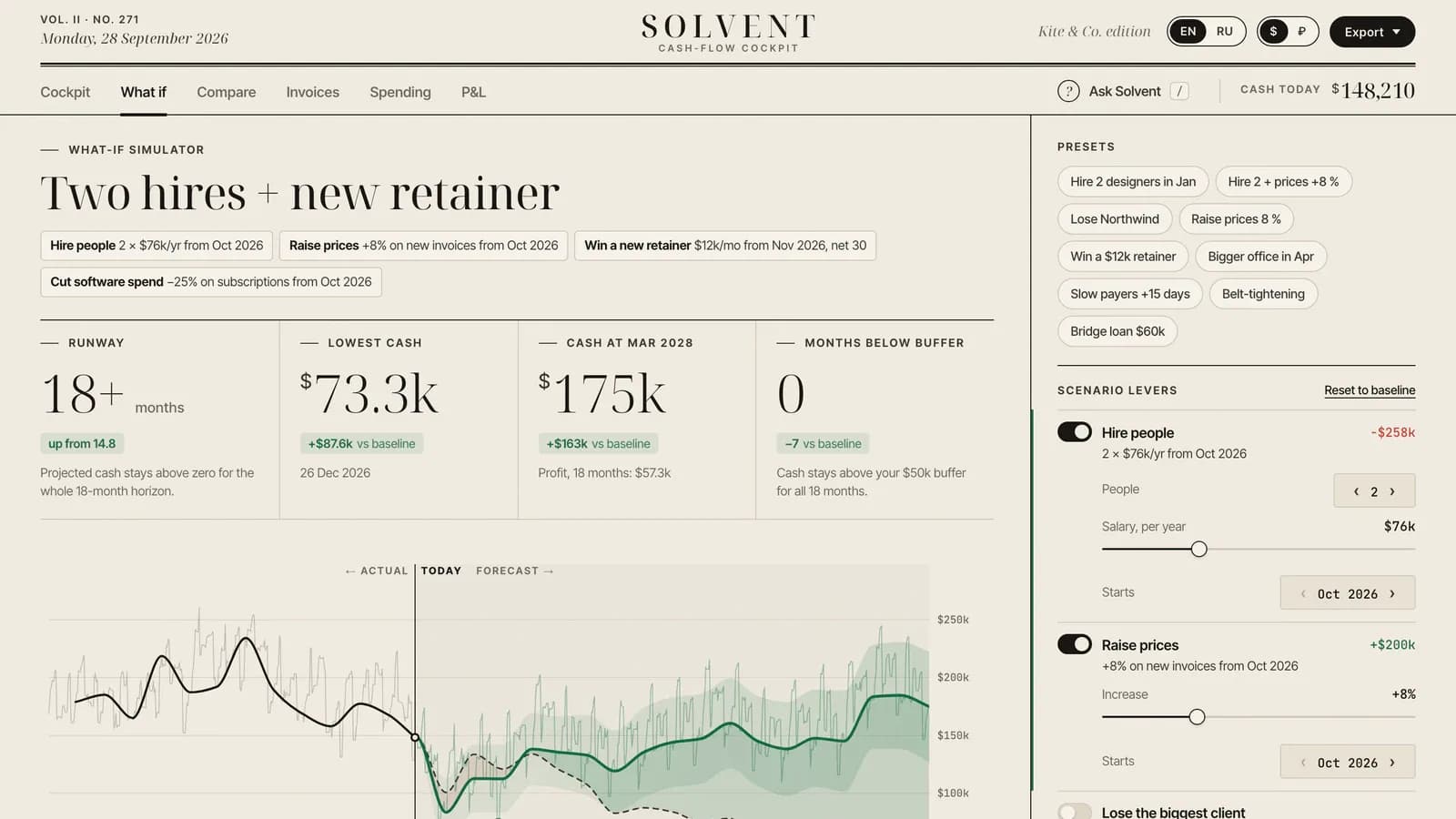
The what-if simulator has eight levers: hire people, raise prices, lose the biggest client, win a new retainer, move to a bigger office, customers pay later, cut software spend or cancel subscriptions, and take a loan. Each has its own settings and start month. There are also nine presets. Every change recomputes the 18-month forecast at once, and the baseline stays as a dashed ghost.
A waterfall shows what each lever adds to or takes from cash at the end of the horizon. Because the levers are attributed one after another, it adds up exactly to the scenario minus the baseline. On one demo screen it starts from the baseline's $12.2k in March 2028. It then runs through hiring at −$258k, higher prices at +$200k, a new retainer at +$192k and cheaper software at +$28.9k to $175k.
Compare lays two saved scenarios over each other, with a table of differences and a one-line verdict. In the demo, hiring two designers in January leaves 7.8 months of runway, while the same hire with prices up 8 % keeps 12.8. In the scenario named “Two hires + new retainer”, runway reaches 18+ months, up from 14.8. One hire becomes a different decision depending on what travels with it.
What the SOLVENT concept does not prove about forecasting
SOLVENT runs on generated data: there is no client, no users, no bank connection, no traffic and no revenue. Its forecast is a simple model that assumes flat demand beyond seasonality and no clients lost when prices rise. Its 80 % band describes the model's own error on invented data. The 1,927 automated checks prove that the maths agrees with its own definitions, not that the forecast would be right for a real business.
It is not accounting software and not advice. Its assistant is rules and statistics in the browser, not a language model. A production version would still need bank feeds, an accounting integration, accounts and roles, encrypted storage and a review by finance professionals. Questions about taxes, loans or how to record a payment belong with your accountant.
Spreadsheet or custom cash dashboard: how to prepare and decide
Either way, the inputs are the same. Collect the balances of every account on one date and the recurring payments with their days of the month. Add open receivables with the dates each client really pays, and the one-off payments you expect this quarter. With those lists, a first cash flow forecast takes an evening in a spreadsheet.
A spreadsheet is enough while one person keeps it, the lines number a few dozen and big decisions are rare. A custom dashboard on top of the accounting data starts to pay off when figures sit in several systems. The same holds when someone rebuilds the table by hand every week, or several people need one view with different rights. At that point the job is software, and the SOLVENT boundary list becomes the brief.
VITON13 Studio is one place that designs and builds such products, starting from the sheet you already keep. The SaaS platform page describes the service, and the SOLVENT case shows the concept screen by screen. The guides on SaaS and MVP cost carry the current prices. A small first version that answers the three owner questions is a sensible start.
Practical checklist
- Write down the balance of every account and the till on one date, and use it as the opening line.
- List each recurring payment with its day of the month: rent, salaries, loans, subscriptions and tax dates from your accountant.
- Put every open invoice on the date this client usually pays, not on the due date printed on it.
- Choose a minimum balance and mark every week in which the forecast falls below it.
- Once a week, replace the past week with actual figures and add a new week at the end.
Questions and answers
How often should a small business update its cash flow forecast?
Weekly is a workable rhythm for most small firms: the past week gets actual figures and a new week is added at the end. When the balance is close to zero, a daily update is safer. A large event, such as losing a client or signing a big order, deserves an update on the same day.
How is a payment calendar different from a cash flow budget?
A cash flow budget plans money in and out for a period such as a month or a quarter. A payment calendar breaks the same plan into days or weeks and names each payment, so it shows whether the account holds enough on a particular date.
Can a business with healthy profits really run out of cash?
Yes. Profit can count a sale when it is made, while the account grows only when the client pays. Late payments, stock bought ahead of the season, prepayments to suppliers and a quarterly tax bill can all empty the account in a month that shows a profit.
How far ahead should a small company plan its cash by date?
Weekly columns for the next quarter and monthly ones after it are a practical layout. Wikipedia's article on forecasting notes that the direct method, listing receipts and payments one by one, is best suited to a short horizon of 30 days; further out, the figures become estimates.
Is SOLVENT built on a real company's accounts?
No. SOLVENT is a VITON13 concept shown on Kite & Co., a fictional design-and-print studio. Its clients, suppliers and figures are generated in the browser, it has no bank connection and no users, and it is not financial advice.