
A polar day that “cannot exist”
December 2024, Union Glacier in Antarctica, about 1,100 kilometres from the South Pole. Nine people are in camp: a Colorado pastor who dreamed up the whole trip, four YouTubers convinced the Earth is flat, and four of their opponents. All day and all night the Sun refuses to set; it just circles above the horizon. On the flat-Earth map Antarctica is a wall of ice around the rim of a disc, and a day like this cannot happen there.
One of the flat-Earth participants, Jeran Campanella, said to the camera: “I thought there was no 24-hour sun. I honestly now believe there is.” It was one of the strangest experiments in the long argument over the shape of the Earth. And that argument began much earlier than most people think, and not where most people think.
The Earth is round, and the Greeks knew it
The short answer to the search “flat Earth” is no: the Earth is not flat. It is very nearly a sphere, slightly squashed at the poles, with a radius of about 6,371 kilometres. The first reasoning that leads there was written down by Aristotle around 350 BC. He watched lunar eclipses: the Earth’s shadow on the Moon is always an arc of a circle, while a flat disc would cast an oval one moment and a line the next. He also knew that travel south from Greece brings stars above the horizon that you never see at home.
Around 240 BC the Alexandrian scholar Eratosthenes went further and measured the size of the sphere. At Syene, today’s Aswan, the midday Sun at the summer solstice stands straight overhead; at Alexandria, 5,000 stadia to the north, a vertical stick casts a shadow of 7.2 degrees, one fiftieth of a circle. Multiply 5,000 by 50 and you get 250,000 stadia. We do not know exactly which stadion he meant, so his error was somewhere between a couple of percent and 15. For a stick, a shadow and arithmetic on papyrus, that is astonishingly close.
The myth of Columbus and the “Dark Ages”
Many of us remember it from school: before Columbus everyone thought the Earth was flat, and the Church threatened anyone who doubted it. This is not true. In the eighth century the English monk Bede defended a spherical Earth. Around 1230 John of Sacrobosco wrote the textbook On the Sphere, which universities across Europe taught from for roughly four centuries. Thomas Aquinas, in the Summa Theologiae, uses “the earth is round” as an everyday example of a conclusion that both physics and mathematics can prove.
The scene in which ignorant monks argue with Columbus was invented by the writer Washington Irving, author of The Legend of Sleepy Hollow, in his novelised 1828 biography of the navigator. The real experts at the Spanish court objected to the size of the Earth, not its shape: they thought India was too far away, and they were right. Historians Draper and White then took the story up because they needed a vivid example of a “war between science and religion”.
The true believers in a flat Earth
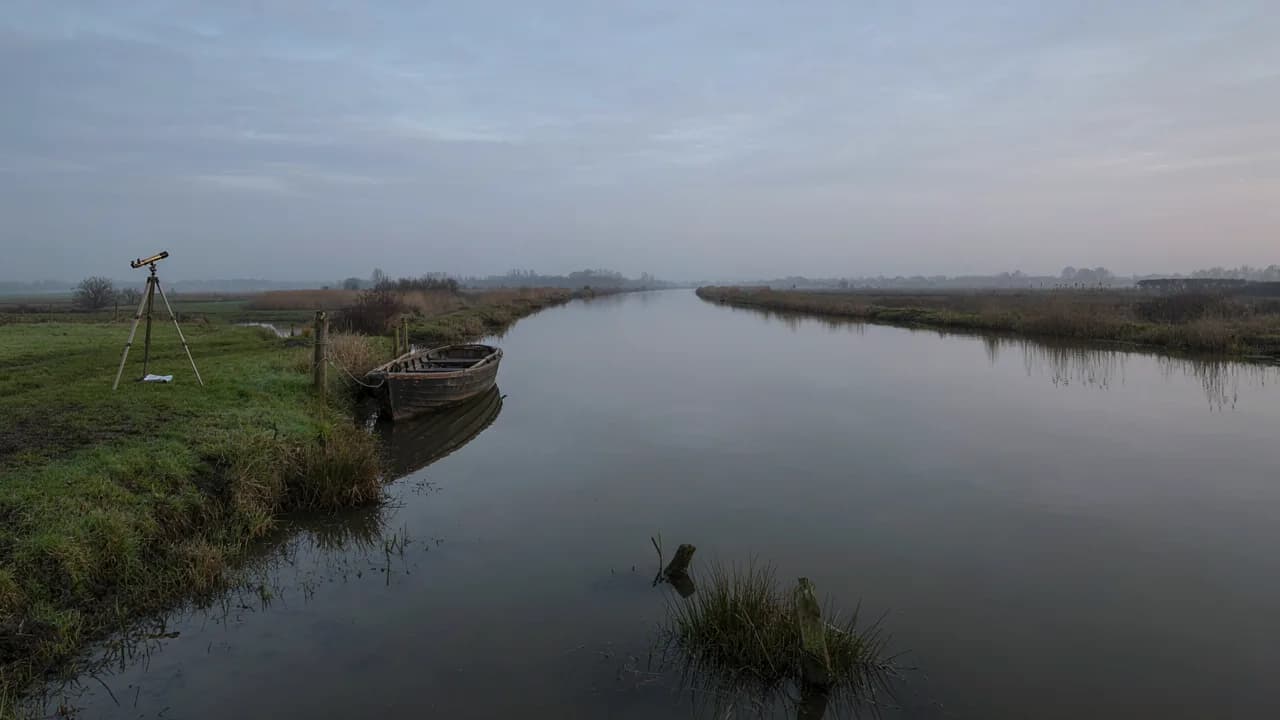
Flat-Earth belief itself is much younger. It can be dated to the summer of 1838, when an Englishman, Samuel Rowbotham, looked through a telescope along a straight canal at six miles of water and decided he saw no curvature. He later devised a flat disc with the North Pole at its centre and a wall of ice around its edge. In 1870 his follower bet £500 with the naturalist Alfred Russel Wallace that he could prove the Earth flat on that same canal. He lost, then spent years in court with Wallace and ended up in prison.
The modern movement began in 1956 with the Flat Earth Society and moved to YouTube in the 2010s. In 2018 came the documentary Behind the Curve: its heroes ran their own experiments, a laser gyroscope and a flashlight shone through holes in styrofoam, and both times got the result a globe predicts. How they explained that to themselves is another story.
What is in the sealed dossier
Further on are the things your school textbook leaves out. What the “flat-Earth map” really is, and why almost the same map sits on the United Nations emblem. The eight main flat-Earth “proofs”, taken one by one. The £500 wager in full detail, down to who stood on which bridge and what it cost the winner. The reading of 15 degrees per hour that spoiled the mood of the owners of a $20,000 gyroscope. And the tests you can run yourself: on a beach, on a rooftop, with a stick and with a fist held at arm’s length.